





 ₹https://clinics.flexifyme.com/flexifyme/-in-pune/-in-hinjewadi/flexifyme-advanced-physiotherapy-clinic-in-hinjewadi-pune--7gAsKd/articles/meniscus-tear-treatment-in-hinjewadi-pune-physiotherapy-recovery-and-rehabilitation-options--8d34c14f-89fc-4d10-92bd-1fc499793f1a
FlexifyMe Advanced Physiotherapy Clinic, Hinjewadi, pune
Physiotherapy Clinic in Hinjewadi, Pune, Maharashtra
No 3/1, Second Floor, Hinjawadi Phase II, Rajiv Gandhi Infotech Park, Hinjewadi, pune, maharashtra - 411057Request A Call Back
FlexifyMe Advanced Physiotherapy Clinic Social Feeds in Hinjewadi, pune
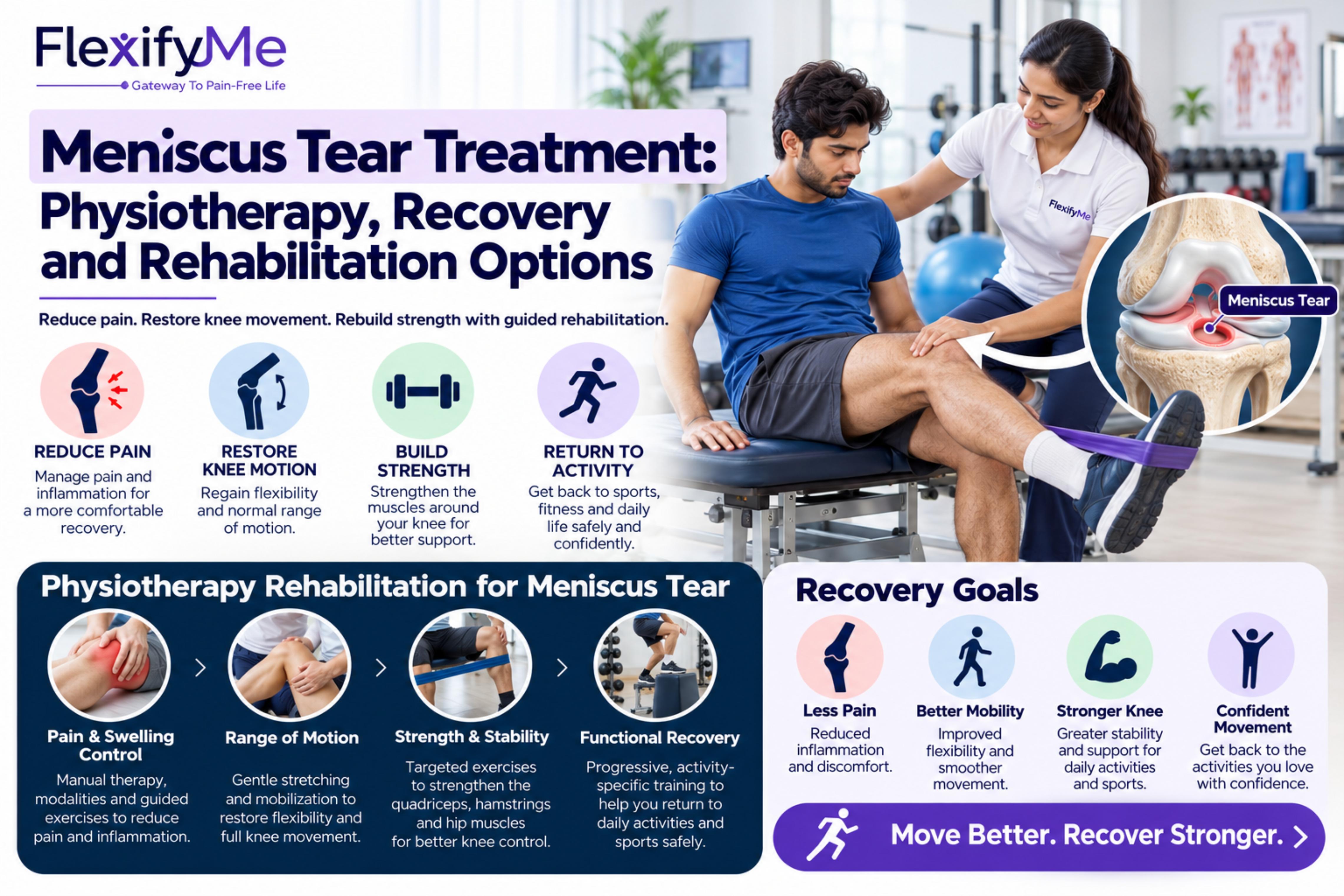
Meniscus Tear Treatment in Hinjewadi, Pune: Physiotherapy, Recovery and Rehabilitation Options
A meniscus tear can sound alarming when it appears on an MRI report. Many people immediately wonder whether surgery is necessary or whether they will be able to walk, exercise and return to their usual activities comfortably.
However, treatment depends on more than the presence of a tear on a scan. The type and location of the tear, the symptoms it causes, the person's age and activity goals, and whether other knee structures are affected all influence the next steps.
Some meniscus tears may be managed with non-surgical treatment and structured rehabilitation. Others, particularly certain traumatic tears or injuries that restrict knee movement, may require assessment by an orthopaedic specialist.
If you are researching meniscus tear treatment in Hinjewadi, Pune, understanding these differences can help you discuss suitable options with your healthcare team.
What Does the Meniscus Do?
Each knee contains two menisci, which are crescent-shaped pieces of cartilage between the thigh bone and shin bone. They help distribute forces across the joint, absorb some of the impact during movement and contribute to knee stability.
A tear can occur after a sudden twisting injury or develop gradually alongside age-related changes in the knee. The resulting symptoms vary, and a tear does not always explain every instance of knee pain.
Traumatic Meniscus Tears
A traumatic tear may occur when the knee twists under load, such as during a sudden change of direction or an awkward landing. These injuries are common in activities that involve pivoting, although they can also happen during everyday movements.
Possible symptoms include:
Pain around the knee joint.
Swelling that develops after the injury.
Difficulty bending or straightening the knee.
Discomfort during twisting or deep bending.
Catching sensations or difficulty moving the knee normally.
A traumatic meniscus tear may occur alongside damage to other structures, including knee ligaments. A clinical assessment is therefore important before starting a rehabilitation programme.
Degenerative Meniscus Tears
Degenerative tears develop alongside changes in the meniscus and other knee structures over time. They may occur without a clearly identifiable injury and are more common in middle-aged and older adults.
Importantly, a degenerative tear seen on an MRI does not necessarily mean it is the cause of knee pain. Some people have meniscal changes without noticeable symptoms.
Treatment decisions should therefore consider the person's symptoms, examination findings and functional limitations rather than relying on the scan report alone.
Symptoms That Need Medical Assessment
Meniscus injuries can produce symptoms that overlap with other knee conditions. Seek medical advice if knee pain persists, swelling recurs or movement becomes difficult.
Arrange prompt assessment after a significant knee injury, especially if you experience substantial swelling, instability or difficulty bearing weight.
A locked knee needs urgent medical assessment. If you cannot fully straighten the knee because movement is physically blocked, do not force it straight or attempt to work through the restriction with exercises.
A locked knee is not the same as occasional clicking or discomfort. Other urgent warning signs include a visibly deformed knee, severe pain or an inability to bear weight after an injury.
A healthcare professional can determine whether further investigation, imaging or orthopaedic review is needed.
Meniscus Surgery or Physiotherapy: Which Is Appropriate?
There is no single treatment that suits every meniscus tear. The decision depends on the tear's characteristics, associated injuries, symptoms and the person's functional goals.
When Non-Surgical Treatment May Be Suitable
For many people with degenerative meniscal tears, especially when there is no true mechanical locking, initial treatment may involve exercise-based rehabilitation and appropriate activity modification.
A structured programme may help improve knee strength, mobility and everyday function. The goal is to reduce the impact of symptoms and help the person return to suitable activities.
However, conservative treatment is not guaranteed to resolve every case. Persistent symptoms, significant instability or new findings may require further assessment.
When Surgery May Be Considered
Surgery may be considered for selected injuries, including certain traumatic tears that are repairable, tears associated with other significant knee injuries, or cases where symptoms and examination findings indicate that an operation may be beneficial.
The type of procedure depends on the injury. Where appropriate, surgeons may consider repairing the meniscus rather than removing torn tissue, although repair is not possible or suitable for every tear.
A scan alone does not determine the need for surgery. An orthopaedic specialist should assess the injury, discuss the options and explain the potential benefits, limitations and rehabilitation requirements.
Why Rehabilitation Matters
Whether treatment is surgical or non-surgical, rehabilitation can help address the movement and strength limitations associated with a knee injury.
A physiotherapist may work on comfortable knee movement, strengthening the muscles around the joint, balance and functional tasks. After surgery, exercises and activity progression must follow the surgeon's protocol.
The aim is to help restore function safely, not to follow a fixed programme regardless of symptoms or clinical findings.
What Does Meniscus Tear Rehabilitation Involve?
The rehabilitation plan depends on the injury, current symptoms and whether surgery has been performed. The following stages describe common goals rather than a universal schedule.
Stage 1: Manage Symptoms and Protect the Knee
Early care may focus on managing pain and swelling while maintaining appropriate movement. Depending on the injury, temporary activity modification or restrictions on weight-bearing may be needed.
Avoid forcing deep squats, twisting movements or exercises that significantly aggravate symptoms. However, complete inactivity is not automatically necessary for every meniscus tear.
If your knee is locked, severely swollen or difficult to bear weight on, seek medical assessment before attempting a routine exercise programme.
Stage 2: Restore Comfortable Movement
When appropriate, rehabilitation may focus on improving knee bending and straightening and making everyday movements more comfortable.
The exercises should reflect the injury and any medical restrictions. After a meniscus repair, for example, the surgeon may prescribe specific limits on knee movement or weight-bearing to protect the repair.
Do not use a general online exercise routine in place of instructions tailored to your injury.
Stage 3: Rebuild Strength
Strengthening exercises may target the quadriceps, hamstrings, gluteal muscles and other muscles that support lower-limb movement.
A physiotherapist can select exercises that match your current ability and progress them as symptoms, movement and strength improve. Depending on your condition, training may begin with controlled exercises and progress towards more demanding functional movements.
Stage 4: Improve Balance and Functional Control
Some rehabilitation programmes include balance and coordination exercises to help improve control during standing, walking and other daily activities.
The programme may gradually introduce single-leg tasks or more demanding movements when appropriate. Progress should be based on your clinical status and ability rather than a predetermined date.
Stage 5: Return to More Demanding Activities
People who want to return to running, gym training or sports may need additional rehabilitation focused on their activity requirements.
This could include progressively reintroducing squatting, running, jumping or changes of direction when the injury and treatment plan permit. After surgery, follow the surgeon's specific guidance on when these activities can begin.
Do not assume that reduced pain alone means the knee is ready for every activity.
How Long Does Meniscus Tear Recovery Take?
Meniscus tear recovery varies considerably. The timeline depends on the tear's location and severity, the person's general health, whether other structures are injured and the treatment selected.
For some people with degenerative tears, symptoms and function may improve with a period of structured rehabilitation. Others may need further assessment if their symptoms persist.
Recovery after surgery also varies by procedure. Rehabilitation after partial meniscectomy generally differs from recovery after meniscus repair, which may involve additional protection while the repaired tissue heals.
For this reason, a single recovery estimate should not be applied to every tear. Your surgeon or physiotherapist can provide guidance based on the diagnosis, procedure if applicable, progress and activity goals.
How Can FlexifyMe Support Knee Rehabilitation?
FlexifyMe offers knee pain treatment and physiotherapy for knee injuries, including meniscus tears. Treatment is guided by the individual's symptoms and assessment.
Clinical Assessment and Movement Analysis
FlexifyMe describes clinical assessment of joint mobility, muscle strength and flexibility, alongside gait and posture analysis. AI posture scanning is listed as available at selected locations.
These assessments may help identify movement limitations and guide an individualised plan. They do not independently confirm the type or severity of a meniscus tear, and they do not replace medical diagnosis or imaging when needed.
Strengthening and Mobility Exercises
FlexifyMe' knee pain treatment strengthening exercises, stretching and mobility work, balance and proprioception training, and home exercise plans among its treatment options.
The suitability of each intervention depends on the person's diagnosis and rehabilitation stage. Exercises should be adapted to any restrictions imposed by an orthopaedic specialist, particularly after meniscus surgery.
Additional Physiotherapy Options
FlexifyMe also lists manual therapy and selected adjunctive therapies, such as cupping, taping and dry needling, on its knee pain treatment. These options are not necessary for every patient and should not be presented as a specific treatment for every meniscus tear.
If you are considering FlexifyMe for knee pain treatment in Hinjewadi, Pune, check the official website for current clinic locations and available appointment options. Confirm that the service can support your particular injury and any post-surgical requirements.
Frequently Asked Questions About Meniscus Tear Treatment
Can a meniscus tear heal without surgery?
Some tears may heal, depending on their location and characteristics. Other tears may not heal structurally but can still become less symptomatic with appropriate rehabilitation. Whether non-surgical treatment is suitable depends on the injury, symptoms and clinical assessment.
Should I avoid squatting permanently after a meniscus tear?
Not necessarily. The appropriate depth and type of squatting depend on the injury, symptoms and stage of rehabilitation. Some people can gradually return to squatting as their knee function improves, while others need specific restrictions. Follow advice tailored to your condition rather than permanently avoiding or prematurely resuming the movement.
Why does my knee swell after activity?
Swelling can occur when an injured or irritated knee is exposed to more activity than it can currently tolerate. However, swelling does not automatically mean that activity has caused no further damage. Recurrent or significant swelling should be assessed, and activity should be adjusted according to clinical guidance.
Is an MRI always necessary for a meniscus tear?
No. The need for MRI depends on the history, physical examination and whether imaging would help guide treatment. MRI can be useful in selected cases, but findings must be interpreted alongside symptoms and clinical assessment.
When should I see an orthopaedic specialist?
Seek medical assessment after a significant knee injury, especially if the knee is locked, severely swollen, unstable or difficult to bear weight on. Specialist review may also be appropriate when symptoms persist despite suitable conservative care or when surgery is being considered.
How do I find a physiotherapist near me for a meniscus tear?
When searching for a physiotherapist near me or physiotherapy near me, look for a qualified professional who can assess knee function and tailor exercises to your diagnosis. If you have had surgery, make sure the rehabilitation plan follows your surgeon's instructions.
If you are considering FlexifyMe, use its official website to confirm available clinics and services before booking.
Choose Treatment Based on the Injury, Not Just the Scan
A meniscus tear does not automatically mean surgery is necessary. For some people, particularly those with degenerative tears and no true mechanical locking, exercise-based rehabilitation may be an appropriate first step. Other injuries need specialist assessment and may require surgical treatment.
The most useful next step is to understand what the tear means for your knee, what activities are currently suitable and which treatment options fit your circumstances.
If you are exploring meniscus tear treatment in Hinjewadi, Pune, consider an assessment with an appropriate healthcare professional. FlexifyMe offers physiotherapy for knee pain and rehabilitation through its listed services. Visit the official website www.flexifyme.com to confirm service availability and discuss whether its physiotherapy options are suitable for your needs.
This article is for general information only and is not a substitute for medical diagnosis or personal treatment advice. Seek prompt medical assessment for a locked knee, inability to bear weight, severe pain, significant swelling or a visibly deformed knee.