


 ₹https://clinics.flexifyme.com/flexifyme/-in-pune/-in-hinjewadi/flexifyme-advanced-physiotherapy-clinic-in-hinjewadi-pune--7gAsKd/articles/carrying-the-ganesh-idol-safely-in-hinjewadi-pune-physiotherapy-tips-to-prevent-shoulder-wrist-and-joint-injuries--457718fe-349c-4f30-acb1-7029787d7f8f
FlexifyMe Advanced Physiotherapy Clinic, Hinjewadi, pune
Physiotherapy Clinic in Hinjewadi, Pune, Maharashtra
No 3/1, Second Floor, Hinjawadi Phase II, Rajiv Gandhi Infotech Park, Hinjewadi, pune, maharashtra - 411057Request A Call Back
FlexifyMe Advanced Physiotherapy Clinic Social Feeds in Hinjewadi, pune
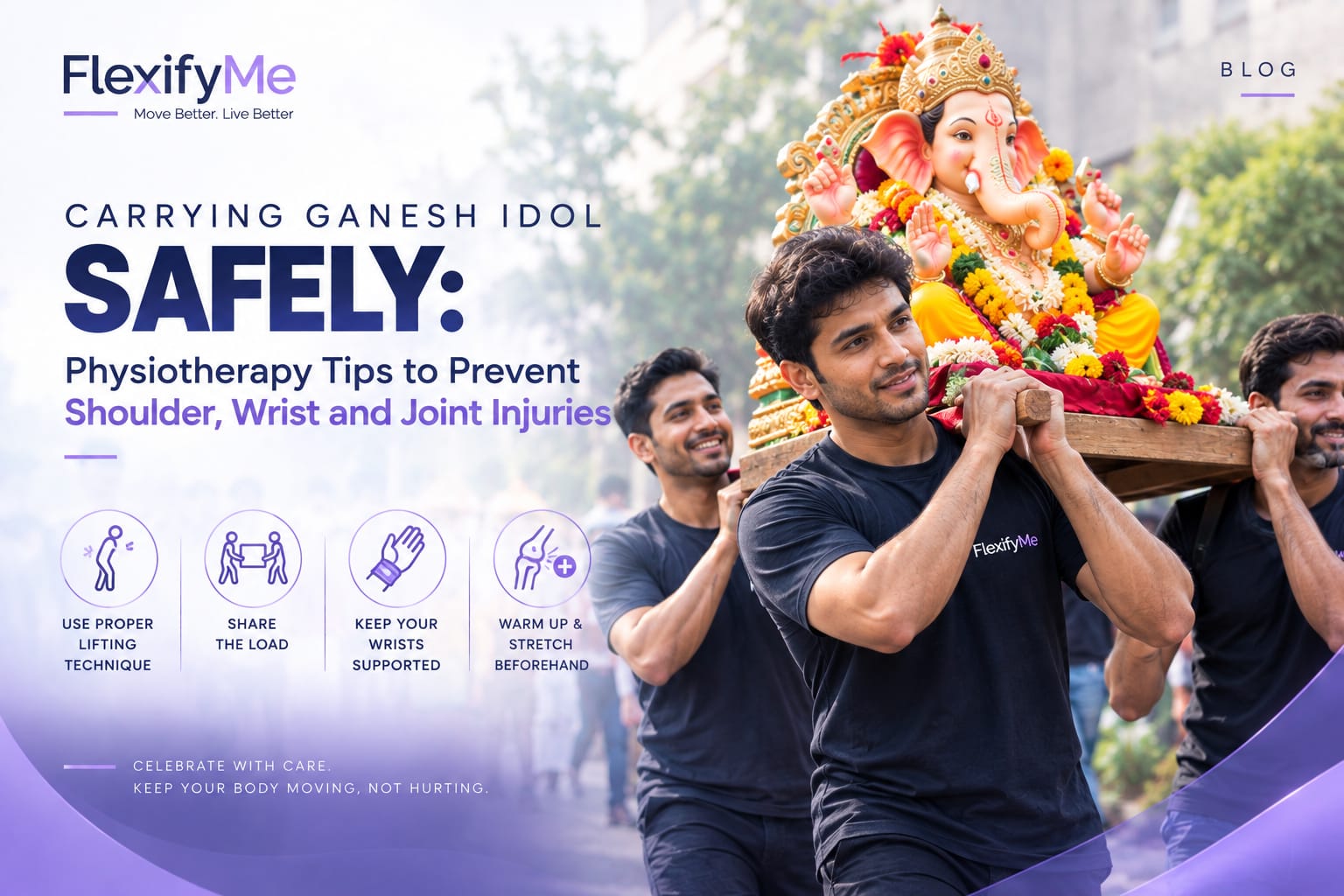
Carrying the Ganesh Idol Safely in Hinjewadi, Pune: Physiotherapy Tips to Prevent Shoulder, Wrist and Joint Injuries
Ganesh Chaturthi brings people together for celebrations, prayers and community activities. For many families and mandals, it also involves lifting, carrying and moving a Ganesh idol.
The physical demand is not limited to the moment when the idol is lifted. Carrying it for an extended period can place stress on the shoulders, wrists, elbows, back, hips, knees and ankles, particularly when the load is awkward, uneven or difficult to control.
Whether you are bringing a small idol home in Hinjewadi or helping with a larger idol elsewhere in Pune, safe handling starts with sharing the load, planning the route and keeping the load under control.
Here is a joint-by-joint guide to carrying a Ganesh idol safely during the festival.
First: Keep the Load Close and Controlled
One of the basic principles of safer manual handling is to avoid unnecessarily holding a heavy or awkward load far away from your body.
When a load is held at arm's length, the muscles around the shoulders and trunk have to work harder to control it. Keeping the load closer, where practical, can make it easier to maintain control.
Before lifting:
Make sure enough people are available.
Decide who will coordinate the movement.
Check the route for steps, turns and uneven surfaces.
Make sure everyone has a stable grip.
Agree on where the idol will be placed.
Lift and lower together rather than moving at different times.
Do not try to manage a heavy idol alone simply because the distance is short.
Protect Your Wrists
The wrists and hands play an important role in controlling an idol, particularly when people are holding handles, supports or the base.
What Can Cause Wrist Discomfort?
Wrist symptoms can develop when the hands and forearms are exposed to prolonged gripping, awkward wrist positions or sudden changes in load.
Potential problems include:
Holding the wrist in an uncomfortable position for too long
Maintaining a tight grip for an extended period
Supporting the load predominantly with one hand
Suddenly taking the weight when another person releases their grip
Repeated lifting and carrying throughout the festival
How to Reduce the Strain
Keep the wrist as neutral and comfortable as possible.
Use both hands when the load and carrying arrangement allow it.
Avoid relying on a fingertip or pinch grip for a heavy load.
Use suitable handles or support surfaces when available.
Share the carrying responsibility rather than allowing one person to grip the load continuously.
If your grip becomes fatigued or painful, stop and change the carrying arrangement.
Do not ignore persistent wrist pain simply because the object being carried is not extremely heavy. Repetitive or prolonged loading can still aggravate an existing problem.
Protect Your Shoulders
The shoulder can be placed under considerable demand when carrying an awkward load, particularly when the arms are held away from the body or above shoulder level.
FlexifyMe's official shoulder-pain information identifies several potential causes of shoulder pain, including rotator cuff injuries, frozen shoulder, shoulder impingement, bursitis, arthritis, instability and postural issues.
Safer Carrying Habits
Keep the load close to your body where practical.
Avoid holding the idol above shoulder height for longer than necessary.
Keep your elbows in a comfortable position rather than continuously reaching forward.
Share the weight across the group.
Change roles if someone begins to feel significant fatigue.
Stop if carrying produces sharp or worsening shoulder pain.
If you already have shoulder pain, do not assume that you can safely participate in heavy lifting simply by changing your technique.
Protect Your Back
The back helps stabilise the body while you lift and carry. Awkward positions, sudden movements and twisting while handling a load can increase physical demand.
Common Problems During Lifting
Watch out for:
Bending awkwardly while picking up the idol
Twisting the trunk while holding the load
Carrying an unstable load
Trying to correct the idol suddenly when it shifts
Continuing after significant fatigue
Lowering the idol without coordinating with the rest of the group
Safer Technique
When lifting from a lower position:
Position yourself close enough to control the load.
Bend through your hips and knees as appropriate.
Maintain a stable stance.
Keep the load controlled as you stand.
Move your feet when changing direction instead of suddenly twisting while carrying.
Coordinate with the other people carrying the idol.
Lower the idol slowly and together.
If the idol is too large or awkward to handle comfortably, increasing the number of people or using an appropriate handling method is safer than relying on individual strength.
Protect Your Knees
Your knees also have to manage your body weight and the load while you lift, walk and use stairs.
Knee discomfort can become more noticeable when people repeatedly squat, kneel or climb and descend steps during festival preparations.
Practical Ways to Reduce Knee Stress
Avoid unnecessary deep squatting while handling a heavy load.
Use a stable position before lifting.
Take your time on stairs.
Use a handrail where appropriate and available.
Do not rush while carrying an idol down steps.
Rotate physically demanding tasks if the festival involves repeated lifting.
If you already have knee pain, avoid taking on tasks that clearly aggravate your symptoms.
Knee pain during festival activities should not automatically be attributed to normal fatigue, particularly when it persists after the activity has stopped.
Do Not Forget Your Neck
The neck can also become uncomfortable during prolonged carrying.
If you are trying to look around or over the idol while carrying it, you may hold your head and neck in an awkward position.
Try to:
Keep your gaze forward when possible.
Ask another person to guide the group when the load blocks your view.
Avoid repeatedly looking upward while carrying.
Take breaks from prolonged carrying.
Stop if you develop significant neck pain, dizziness or other concerning symptoms.
A clear route and a designated person to guide the carriers can be safer than asking the person carrying the idol to look around constantly.
Think Beyond the Main Lifting Day
Ganesh Chaturthi involves more than one lifting event.
Depending on the individual's role, the festival may include decorating, moving materials, arranging the space, carrying supplies, standing for long periods and repeatedly handling objects.
Instead of putting all the physically demanding tasks on one person:
Share the workload.
Rotate tasks when practical.
Take appropriate breaks.
Stay hydrated.
Avoid continuing an activity that is causing increasing pain.
Allow adequate rest between demanding activities.
If a particular movement repeatedly causes discomfort, changing the task is more sensible than repeatedly testing the same painful movement.
What If a Joint Becomes Painful?
If your shoulder, wrist, knee or another joint becomes painful while carrying the idol, stop the activity that is aggravating it.
You can:
Reduce the load on the affected area.
Avoid movements that clearly increase the pain.
Keep the joint moving gently within a comfortable range when appropriate.
Give yourself time to recover before returning to demanding activity.
Seek professional assessment if symptoms persist or interfere with normal movement.
Avoid assuming that every painful joint is simply a minor strain. The appropriate treatment depends on the cause.
When Should You Seek Medical Assessment?
Seek prompt medical attention if you experience:
Severe pain following a fall or accident
An obvious deformity
Inability to use the affected limb normally
Significant swelling
New numbness or weakness
Severe or rapidly worsening symptoms
Persistent pain or restricted movement also deserves assessment, particularly if it is affecting everyday activities.
How Physiotherapy Can Help
If shoulder, wrist, knee, ankle or other musculoskeletal symptoms continue after the festival, physiotherapy can help assess the problem and guide rehabilitation.
FlexifyMe's current official website describes personalised physiotherapy based on assessment of the individual's condition and movement needs. Its services include therapeutic exercises, posture correction, mobility training, manual therapy and movement-based rehabilitation, depending on the condition.
For shoulder pain specifically, FlexifyMe's official treatment information describes assessment of posture, range of motion, strength and functional movement. It also lists approaches such as manual therapy, exercise therapy, postural correction, shoulder stabilisation training and personalised home exercises.
FlexifyMe also uses AI-assisted posture and movement analysis in its assessment approach. The official AI Postural Assessment page explains that the technology can help identify postural imbalances, alignment issues and movement patterns, supporting the physiotherapist's assessment.
Online physiotherapy is also available through FlexifyMe, while physical clinic availability depends on the location. The official website recommends assessment to determine whether online care is suitable and notes that cases requiring hands-on examination may need in-person evaluation.
Frequently Asked Questions
Why do my wrists hurt after carrying an idol?
Wrist discomfort can result from prolonged gripping, awkward wrist positioning, repetitive carrying or suddenly taking more of the load than expected.
Using both hands when practical, sharing the load and avoiding prolonged uncomfortable wrist positions can help reduce unnecessary strain.
Is a back belt necessary when carrying a Ganesh idol?
A back belt should not be treated as a substitute for safe handling. The more important considerations are having enough people, keeping the load controlled, avoiding unnecessary twisting and using an appropriate carrying method.
If you already have back pain, seek appropriate professional advice before taking on heavy lifting.
What is a safer way to carry a small Ganesh idol?
Use both hands where practical, maintain a stable grip, keep the idol close to your body when possible and make sure your path is clear.
If the idol is awkward or heavier than expected, ask another person to help rather than trying to manage it alone.
Should I warm up before lifting?
A short period of gentle movement can be useful before demanding physical activity. Consider comfortable movements such as walking, shoulder rolls and other light movements rather than forcing deep stretches.
If you have an existing injury or medical condition, your preparation should be appropriate for your individual situation.
How do I find a physiotherapist near me for joint pain?
Search for physiotherapist near me or physiotherapy near me and look for a provider that offers assessment-based care for your particular problem.
FlexifyMe provides personalised physiotherapy for a range of pain, injury and mobility conditions, with online physiotherapy also available. Physical clinic availability varies by location.
When should I see a physiotherapist after carrying an idol?
Consider an assessment if pain persists, movement remains restricted, symptoms interfere with everyday activities, or the same problem keeps returning.
Do not wait for a routine physiotherapy appointment if you have a serious injury, obvious deformity, significant weakness or numbness. Those symptoms require appropriate medical assessment.
Protect Every Joint While Celebrating Ganesh Chaturthi
Carrying a Ganesh idol safely is not just about protecting your back. Your shoulders, wrists, elbows, knees, ankles and other parts of the body all contribute to lifting, carrying and controlling the load.
Use enough people, keep the load controlled, avoid unnecessary twisting, communicate throughout the lift and take breaks when fatigue starts affecting your technique.
If you develop persistent shoulder, wrist, knee or other joint pain during or after the celebrations, do not simply continue working through it. Professional assessment can help identify the cause and determine whether physiotherapy or another form of care is appropriate.
For people searching for wrist strain treatment in Hinjewadi, Pune, physiotherapist near me, or physiotherapy near me, FlexifyMe offers personalised physiotherapy and online care options, subject to location and individual assessment. (flexifyme.com)
This article is intended for general information and does not replace an individual medical assessment. Seek prompt medical attention for severe pain, significant swelling, deformity, inability to use a limb, numbness or new weakness after an injury.