







 ₹https://clinics.flexifyme.com/flexifyme/-in-pune/-in-hinjewadi/flexifyme-advanced-physiotherapy-clinic-in-hinjewadi-pune--7gAsKd/articles/acl-injury-treatment-in-hinjewadi-pune-physiotherapy-rehabilitation-for-a-safe-return-to-activity--57bb3125-4317-4b2c-bb7c-86d0efa7c8de
FlexifyMe Advanced Physiotherapy Clinic, Hinjewadi, pune
Physiotherapy Clinic in Hinjewadi, Pune, Maharashtra
No 3/1, Second Floor, Hinjawadi Phase II, Rajiv Gandhi Infotech Park, Hinjewadi, pune, maharashtra - 411057Request A Call Back
FlexifyMe Advanced Physiotherapy Clinic Social Feeds in Hinjewadi, pune
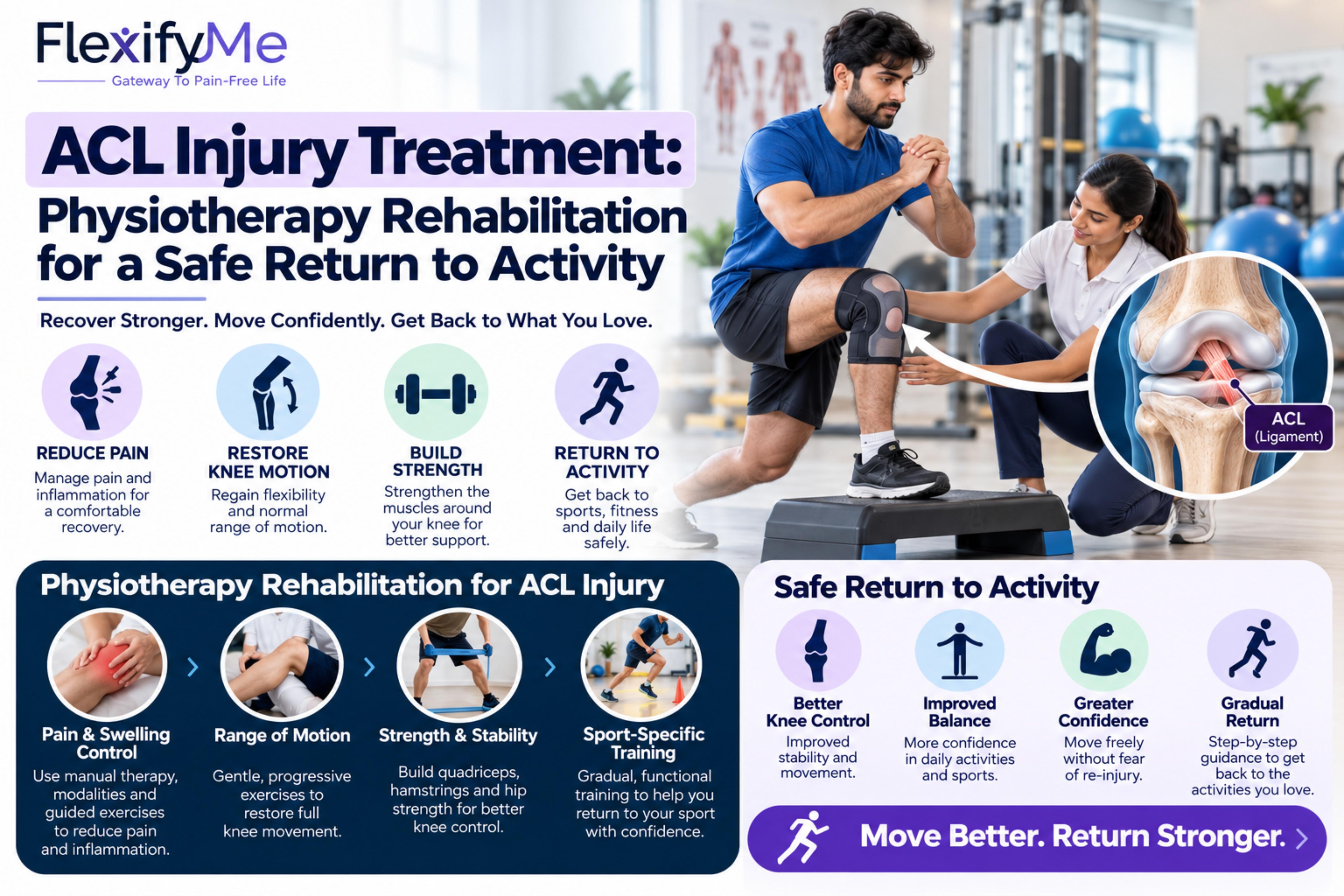
ACL Injury Treatment in Hinjewadi, Pune: Physiotherapy Rehabilitation for a Safe Return to Activity
An anterior cruciate ligament (ACL) injury can affect more than your ability to play sports. A sudden twist, awkward landing or change of direction may leave the knee painful, swollen or unstable. Activities that once felt routine, such as climbing stairs, walking on uneven ground or changing direction quickly, may become difficult.
Recovering from an ACL injury involves more than waiting for pain and swelling to settle. The right treatment depends on the extent of the injury, whether other knee structures are affected, your daily activities and your future goals. Physiotherapy can play an important role in restoring strength, movement and control, whether rehabilitation is recommended without surgery or forms part of recovery after an operation.
If you are looking for ACL injury treatment in Hinjewadi, Pune, understanding the rehabilitation process can help you make informed decisions and discuss realistic goals with your healthcare team.
What Is an ACL Injury?
The anterior cruciate ligament is one of the major ligaments inside the knee. It helps stabilise the joint, particularly during movements that involve rotation, sudden stops and changes of direction.
An ACL injury may occur during sports such as football, basketball, badminton or kabaddi. It can also happen during everyday activities involving an awkward landing, a sudden pivot or a fall.
Common signs of an ACL injury include:
A popping sensation or sound at the time of injury.
Swelling that develops relatively quickly.
Pain and difficulty continuing the activity.
Reduced knee movement.
A feeling that the knee may give way, particularly during turning movements.
These symptoms do not confirm an ACL tear on their own. Other knee injuries can produce similar signs, and an ACL injury may occur alongside damage to the meniscus or other ligaments.
When Should You Seek Medical Assessment?
Arrange a prompt medical assessment after a significant knee injury, particularly if you experience substantial swelling, instability or difficulty moving the knee.
Seek urgent medical care if you cannot bear weight, the knee looks deformed, the joint locks, or you experience severe pain. Do not try to test the knee by repeatedly twisting, jumping or changing direction.
A healthcare professional can assess the injury and determine whether further examination or imaging is needed. An accurate diagnosis is important before deciding on an appropriate rehabilitation plan.
ACL Injury Treatment: Is Surgery Always Necessary?
Not every ACL injury requires reconstruction surgery. The appropriate approach depends on the severity of the injury, knee stability, associated damage, activity requirements and the advice of an orthopaedic specialist.
When Surgery May Be Considered
ACL reconstruction may be considered for people who experience persistent knee instability, want to return to sports involving pivoting and rapid direction changes, or have associated injuries that require surgical management.
The decision should follow a detailed assessment and discussion of the potential benefits, risks and rehabilitation commitments. Age alone does not determine whether surgery is necessary.
When Non-Surgical Management May Be Appropriate
Some people can manage an ACL injury without reconstruction, particularly when their activity goals do not involve demanding pivoting movements and the knee can be stabilised through appropriate rehabilitation.
Non-surgical treatment may include progressive strengthening, movement training and exercises designed to improve knee control. However, persistent instability or associated injuries may change the treatment recommendation.
A non-surgical approach is not suitable for everyone, and strengthening cannot guarantee that an unstable knee will become safe for every activity.
Why Rehabilitation Matters in Both Approaches
Surgery does not immediately restore the strength, coordination and movement control required for everyday activities or sport. Similarly, non-surgical management requires a structured approach rather than simply waiting for symptoms to improve.
Physiotherapy can help address movement limitations, rebuild strength and guide progression towards relevant functional goals. When surgery is involved, the surgeon's instructions and rehabilitation protocol must take priority.
The Stages of ACL Rehabilitation
ACL rehabilitation is a progressive process. The stages below describe common rehabilitation goals, not a fixed schedule. Your progression depends on the nature of the injury, whether surgery was performed, associated injuries and your response to treatment.
Stage 1: Manage Symptoms and Restore Knee Movement
Early rehabilitation generally focuses on managing swelling, improving comfortable knee movement and restoring quadriceps activation.
Regaining the ability to straighten the knee is particularly important because limited extension can affect walking and later exercises. The appropriate exercises and level of activity depend on the injury and medical advice.
If surgery is planned, a physiotherapist may also help prepare the knee before the procedure when recommended by the treating team. This is often called prehabilitation.
Do not force the knee through pain or begin demanding exercises without appropriate guidance.
Stage 2: Improve Walking and Build Basic Strength
As symptoms and movement allow, rehabilitation can progress towards more comfortable walking and controlled strengthening.
Exercises may target the quadriceps, hamstrings, gluteal muscles and calf muscles. These muscle groups contribute to lower-limb movement and control, but the exact exercise selection should reflect the person's needs and any restrictions.
The aim is to develop a foundation for more demanding tasks without progressing faster than the knee can tolerate.
Stage 3: Develop Strength and Movement Control
Once basic movement and strength have improved sufficiently, the programme may progress to more challenging exercises.
Depending on the rehabilitation plan, these can include resistance exercises, controlled single-leg activities and functional movements. Progress should be based on movement quality, strength, symptoms and clinical assessment rather than simply the number of weeks since injury or surgery.
This stage is important because feeling better during everyday walking does not necessarily mean the knee is ready for demanding physical activity.
Stage 4: Prepare for Running, Jumping and Landing
For people whose goals include running or sport, rehabilitation may eventually include appropriate running progressions, jumping, landing and single-leg control exercises.
These activities place different demands on the knee. They should be introduced only when the treating professional considers them appropriate.
Movement quality matters alongside strength. Exercises may focus on maintaining control during landing and reducing unwanted knee movement under increasing physical demands.
Stage 5: Progress Towards Direction Changes and Sport-Specific Movement
Sports involving rapid turns, pivots, acceleration and deceleration place additional demands on knee stability and control.
When appropriate, rehabilitation may progress towards agility drills and sport-specific movements. The difficulty and intensity should increase gradually under professional guidance.
An athlete who can jog in a straight line may still need further rehabilitation before safely performing cutting movements or returning to competitive play.
Stage 6: Gradual Return to Training and Sport
Returning to sport should be a planned process rather than a single decision based on elapsed time.
Depending on the individual's sport and rehabilitation goals, progression may involve modified training, more demanding practice, full training sessions and eventually competitive participation.
The treating team should assess readiness and consider the person's strength, movement control, symptoms, psychological confidence and sport-specific demands. The surgeon's protocol must be followed after reconstruction.
How Long Does ACL Recovery Take?
There is no single ACL tear recovery time that applies to everyone. Recovery depends on the type and severity of the injury, associated damage, whether surgery is performed, rehabilitation progress and the demands of the intended activity.
After ACL reconstruction, returning to sports that involve pivoting and rapid direction changes often takes many months and may take around nine to twelve months or longer. This is a broad reference range, not a clearance date or a guarantee of recovery.
Walking and everyday activities may improve before the knee has regained the strength and control required for sport. Feeling less pain does not necessarily mean that the ligament and surrounding muscles are ready for high-demand movements.
Progress should therefore be assessed using relevant clinical and functional criteria. Avoid returning to competition simply because a particular month has arrived.
What Does a Safe Return to Sport Involve?
A return-to-sport decision should consider more than whether the knee feels comfortable. Depending on the injury, surgery and sport, the treating team may assess:
Knee movement: Whether the required range of motion has been restored.
Strength: Whether the quadriceps, hamstrings and other relevant muscles have regained sufficient strength.
Functional performance: Whether appropriate balance, hopping or other movement tests can be completed safely.
Movement quality: Whether landing, deceleration and changes of direction can be performed with suitable control.
Training tolerance: Whether the person can progress through relevant training activities without concerning symptoms.
Confidence and readiness: Whether the person feels prepared for the movements and demands involved.
Specific testing requirements and clearance thresholds vary. No single test or strength comparison can independently guarantee that another ACL injury will not occur.
If you are unsure whether your knee is ready for running, jumping or sport, consult your physiotherapist and orthopaedic specialist rather than relying on pain levels or a calendar.
How Can Physiotherapy Help With ACL Rehabilitation?
Physiotherapy can support rehabilitation by addressing movement limitations, strength, balance and functional performance. The treatment plan should reflect the injury, any surgical restrictions and the activities the person wants to resume.
Assessment and Personalised Planning
A physiotherapist can assess relevant movement and functional limitations and use the findings to help plan rehabilitation.
FlexifyMe offers AI-assisted posture and movement assessment, expert clinical evaluation, functional retraining, and gait training as part of its physiotherapy services.
These are general service descriptions. They should not be interpreted as confirmation that every assessment method or therapy is included in every ACL rehabilitation plan.
Progressive Exercise and Functional Training
ACL rehabilitation commonly requires carefully progressed exercises to rebuild strength and movement control. The exercises should match the person's current ability and the instructions provided by the treating medical team.
FlexifyMe describes personalised physiotherapy planning and functional re-training among its services. Whether a particular programme is suitable for an ACL injury, and how it should be structured, must be determined through an appropriate assessment.
Support During Post-Surgical Rehabilitation
FlexifyMe includes ACL reconstruction rehabilitation among the areas of expertise of its listed physiotherapists. Service availability may vary by centre and practitioner.
If you have undergone ACL surgery, confirm that the selected physiotherapist can work with your surgeon's rehabilitation protocol and any restrictions related to the procedure or associated injuries.
What About Other Physiotherapy Therapies?
FlexifyMe offers services such as manual therapy, kinesiology taping, dry needling, and cryotherapy at selected locations. The suitability of these therapies for ACL rehabilitation depends on individual assessment and treatment needs.
The suitability of any additional therapy depends on the clinical assessment, the stage of rehabilitation and the treating professional's judgement. Such therapies do not replace the progressive strengthening and functional work needed to meet rehabilitation goals.
If you are considering FlexifyMe for ACL surgery rehabilitation or non-surgical knee rehabilitation, check the official website for current clinic locations and service availability before booking.
Frequently Asked Questions About ACL Injury Treatment
Can an ACL tear heal without surgery?
Some people manage an ACL injury without reconstruction, depending on knee stability, associated injuries and activity goals. A completely torn ACL does not reliably restore its original mechanical function through exercise alone. Medical assessment is important to determine the appropriate approach.
Is a knee brace necessary after ACL surgery?
Brace use depends on the surgeon's protocol, the procedure and the individual's circumstances. Follow the instructions provided by your surgical and rehabilitation team rather than using a brace or changing its use without advice.
Why does my knee still feel unstable during rehabilitation?
Instability can have several causes, including muscle weakness, reduced movement control or an ongoing structural problem. It should not automatically be attributed to weakness or assumed to be harmless. Consult your physiotherapist or orthopaedic specialist for an assessment.
Can I return to sport six months after ACL surgery?
Some people may be progressing towards selected activities by this point, but six months should not be treated as a universal return-to-sport target. Sports involving pivoting and rapid direction changes often require a longer rehabilitation period and assessment against relevant readiness criteria.
How do I find a physiotherapist near me for ACL rehabilitation?
When searching for a physiotherapist near me or physiotherapy near me, look for a qualified professional with relevant knee injury or post-surgical rehabilitation experience. Ask how progress is assessed, how exercises are progressed and whether the rehabilitation plan can follow your surgeon's instructions.
If you are considering FlexifyMe, review the current clinic locations and appointment options on its official website. Confirm that the selected service can support your particular rehabilitation needs.
Build a Stronger Foundation Before Returning to Activity
ACL rehabilitation is about more than getting back on your feet. Strength, movement control, functional performance and confidence all contribute to preparing for the demands of daily life and sport.
Whether your treatment involves surgery or non-surgical management, follow an individualised rehabilitation plan and progress according to clinical guidance rather than a fixed timeline.
If you are exploring ACL injury treatment in Hinjewadi, Pune, consider a physiotherapy assessment to discuss your movement limitations, rehabilitation goals and suitable next steps. FlexifyMe provides physiotherapy through listed clinic locations and online services. Visit the official website www.flexifyme.com to check current availability and determine which appointment options may suit your needs.
This article is for general information only and is not a substitute for medical diagnosis or personal treatment advice. ACL injuries require appropriate clinical assessment. Follow your orthopaedic specialist's instructions after surgery, and do not return to sport until you have received appropriate clearance. Seek urgent medical care for a deformed knee, inability to bear weight, a locked joint or severe symptoms.