







 ₹https://clinics.flexifyme.com/flexifyme/pune/hinjewadi/flexifyme-advanced-physiotherapy-clinic-in-hinjewadi-pune--7gAsKd/articles/herniated-disc-treatment-in-hinjewadi-pune-options--61e2dab5-9508-4420-b69d-68b94bf0cad9
FlexifyMe Advanced Physiotherapy Clinic, Hinjewadi, pune
Physiotherapy Clinic in Hinjewadi, Pune, Maharashtra
No 3/1, Second Floor, Hinjawadi Phase II, Rajiv Gandhi Infotech Park, Hinjewadi, pune, maharashtra - 411057Request A Call Back
FlexifyMe Advanced Physiotherapy Clinic Social Feeds in Hinjewadi, pune
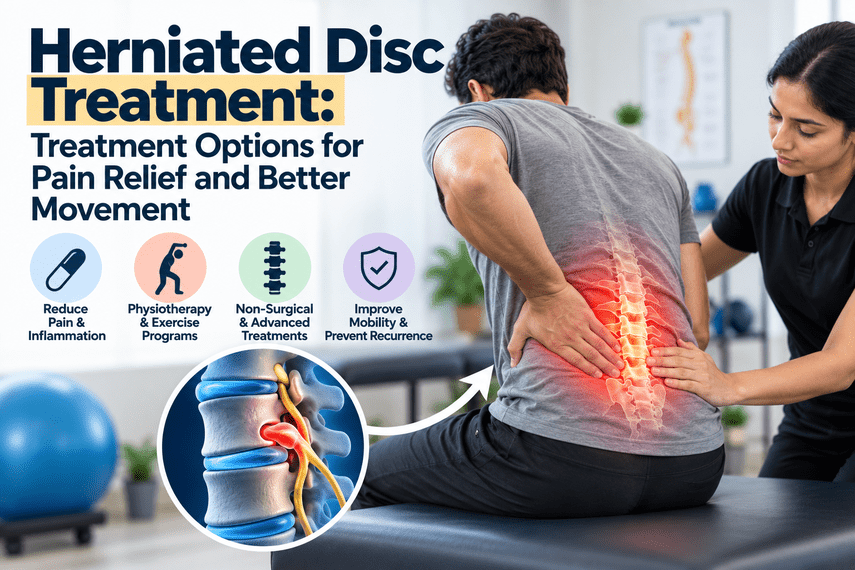
Herniated Disc Treatment in Hinjewadi, Pune: Options for Pain Relief and Better Movement
When someone is diagnosed with a herniated disc, one of the first questions is usually, “What are my treatment options, and will I need surgery?”
The answer depends on the location of the disc herniation, the symptoms it is causing, neurological findings, overall health and how symptoms change over time. Many people improve with non-surgical care, and surgery is not usually the first treatment for an uncomplicated herniated disc.
If you are considering herniated disc treatment in Hinjewadi, the important thing is to understand what each option is designed to do and when it may be considered.
First, know the emergency warning signs
Most herniated discs are not emergencies. However, certain symptoms require urgent medical assessment.
Seek emergency medical care if you develop:
Difficulty passing urine or loss of bladder control
Loss of bowel control
Numbness around the groin, genitals, buttocks or inner thighs
Significant or rapidly worsening weakness in the legs
Severe neurological symptoms affecting walking or normal movement
These symptoms can be associated with cauda equina syndrome, a rare but serious condition caused by compression of nerves at the lower end of the spinal canal. Urgent assessment is important because untreated cauda equina syndrome can result in permanent neurological problems.
You should also seek prompt medical evaluation if back or leg pain occurs with fever, significant recent trauma, a history of cancer or other concerning symptoms.
Herniated Disc Treatment Options Compared
1. Staying active and modifying activities
What it does: Helps you continue everyday movement while temporarily reducing activities that significantly aggravate your symptoms.
Where it fits: Often part of early conservative care.
Complete or prolonged bed rest is generally not recommended for uncomplicated herniated disc symptoms. Gentle movement and walking as tolerated can help maintain mobility while symptoms settle. The amount and type of activity should be adjusted according to your symptoms and clinical assessment.
The goal is not to avoid movement permanently. It is to find a level of activity that you can manage safely and gradually build from there.
2. Medication
What it does: Helps manage pain and inflammation so that normal activities and rehabilitation may be easier.
Where it fits: Medication can be part of short-term symptom management and should be selected with appropriate medical advice.
Pain medicines do not physically repair a herniated disc. Your doctor can consider factors such as your symptoms, other medicines, medical history and potential contraindications before recommending an appropriate option.
3. Physiotherapy and structured rehabilitation
What it does: Physiotherapy can help assess movement, manage symptoms, restore mobility and progressively rebuild physical capacity.
Where it fits: It may be included in non-surgical management when appropriate.
A physiotherapy programme is not necessarily the same for every person with a disc herniation. The plan may change depending on whether you have mainly back pain, radiating leg pain, numbness, weakness, movement limitations or other symptoms.
FlexifyMe's official treatment information includes disc bulge and slipped disc among the conditions it treats. Its approach combines AI-assisted posture and movement analysis with physiotherapy and personalised recovery planning.
The focus should be on progressing movement and function according to your assessment rather than following a fixed exercise routine.
4. Spinal decompression therapy
What it does: FlexifyMe describes spinal decompression as a non-surgical, traction-based physiotherapy technique intended to reduce pressure on the spine and intervertebral discs.
Where it fits: It may be considered as part of an in-clinic treatment plan for suitable patients.
FlexifyMe specifically lists decompression therapy for conditions including herniated or bulging discs and sciatica. Its official page also states that a physiotherapist should evaluate whether the therapy is appropriate for an individual patient.
The availability of this therapy is location-dependent. FlexifyMe currently highlights decompression therapy at selected clinics rather than presenting it as a treatment available at every location.
5. Other physiotherapy therapies
What they do: Depending on the assessment, additional physiotherapy techniques may be used to support pain management, mobility and rehabilitation.
FlexifyMe's current therapy catalogue includes options such as manual therapy, IFT and TENS, ultrasound therapy, cupping, dry needling, Matrix Rhythm Therapy, cryotherapy and kinesiology taping. The exact combination depends on the patient's condition and assessment rather than being automatically prescribed for every herniated disc.
This distinction matters. A treatment appearing in a clinic's therapy catalogue does not mean that it is appropriate for every person with a disc problem.
6. Epidural or nerve root injections
What they do: A doctor may recommend an injection to help manage severe radiating nerve pain in selected cases.
Where they fit: They may be considered when symptoms are significant and other non-surgical measures have not provided enough relief.
Injections are medical procedures and are not a way to physically repair a herniated disc. Whether one is appropriate depends on the individual's symptoms, examination and medical assessment.
7. Surgery
What it does: Surgery can relieve pressure on a compressed nerve by removing the herniated portion of the disc or using another appropriate surgical technique.
Where it fits: Surgery may be considered when symptoms remain significantly disabling despite appropriate non-surgical care, or when neurological problems such as progressive weakness develop. Emergency surgery may be required for cauda equina syndrome.
There is no single recovery period that determines whether everyone needs surgery. The decision depends on the symptoms, neurological findings, imaging when appropriate and response to non-surgical treatment.
What Can You Expect During Herniated Disc Recovery?
Recovery is different for every person. Many people with lumbar disc-related nerve symptoms improve with conservative treatment over time. The American Association of Neurological Surgeons notes that improvement can occur over days to weeks, although the exact course varies between individuals.
Pain may improve before numbness, tingling or weakness completely settle. This is one reason recovery should be monitored based on symptoms and function rather than a fixed timetable.
Your physiotherapist or doctor may gradually work towards:
Increasing comfortable everyday movement
Improving tolerance for sitting, standing and walking
Restoring appropriate spinal and hip movement
Building strength and physical capacity
Returning to work, exercise or sport according to your condition
Reducing unnecessary fear or avoidance of movement
The progression should be individualised. A movement that is appropriate during one stage of recovery may need to be modified during another.
How FlexifyMe Approaches Assessment and Movement
FlexifyMe's current website describes an assessment process that combines technology with clinical physiotherapy. Its platform includes AI-assisted posture and movement analysis, while its current in-clinic process can also include gait and movement analysis and foot and pressure analysis.
The purpose is to provide physiotherapists with additional movement information that can contribute to a personalised recovery plan. The assessment is not a replacement for clinical evaluation.
FlexifyMe also offers Functional Re-Training, which focuses on improving movement patterns used for activities such as walking, sitting, standing, reaching and lifting. The official site describes it as a personalised physiotherapy approach used in injury recovery and other rehabilitation settings.
For someone recovering from a herniated disc, the appropriate rehabilitation approach depends on the clinical assessment, symptoms and functional goals.
Do You Need an MRI for a Herniated Disc?
Not everyone with back pain or suspected disc-related symptoms needs an MRI immediately.
Imaging decisions depend on the clinical picture, including symptoms, examination findings and whether there are warning signs or a reason to consider specialist treatment. MRI may be appropriate when symptoms persist, neurological problems are present or surgery is being considered.
It is also important to remember that disc changes can appear on scans in people who do not have symptoms. An imaging report therefore needs to be interpreted alongside the person's symptoms and clinical examination.
Frequently Asked Questions
Can a herniated disc heal without surgery?
Many people with herniated discs improve without surgery. Conservative management may include staying active within tolerable limits, medication when appropriate and physiotherapy. Surgery is considered for selected cases, particularly when significant or progressive neurological problems occur or symptoms remain substantially disabling.
Is spinal decompression therapy the same as surgery?
No. FlexifyMe describes spinal decompression therapy as a non-surgical, traction-based physiotherapy treatment. Surgical decompression is an operation performed to relieve pressure on compressed nerves. They are different treatments and should not be treated as interchangeable.
Should I stop bending if I have a herniated disc?
Avoiding every bending movement indefinitely is generally not the goal of rehabilitation. During an irritable phase, some movements may need to be modified according to symptoms. As recovery progresses, movement and physical capacity can be gradually rebuilt under appropriate guidance.
Can walking help with a herniated disc?
Walking can be part of maintaining activity during recovery when it is comfortable and does not significantly aggravate symptoms. The appropriate amount varies between individuals. Prolonged bed rest is generally not recommended.
Where can I find a physiotherapist near me for a herniated disc?
If you are searching for a physiotherapist near me or physiotherapy near me, look for a provider that begins with an appropriate assessment and can identify neurological warning signs before creating a rehabilitation plan.
FlexifyMe provides physiotherapy online and through physical centres in selected locations. Its current website lists clinic options in locations including Pune, Mumbai and Delhi NCR, so in-person availability should be confirmed for your specific Hinjewadi, Pune.
Choosing the Right Herniated Disc Treatment
There is no single treatment that works in the same way for every herniated disc.
For many people, treatment begins with appropriate activity modification, symptom management and physiotherapy-based rehabilitation. Additional options such as spinal decompression or other in-clinic therapies may be considered when they are appropriate for the individual. Medical injections or surgery may be considered in selected cases, particularly when symptoms are severe, persistent or associated with neurological problems.
If you are looking for herniated disc treatment in Hinjewadi, Pune, a proper assessment can help determine which options are appropriate for your symptoms and whether online or in-person physiotherapy is suitable.
FlexifyMe combines AI-assisted posture and movement assessment with physiotherapy and personalised rehabilitation planning. Its current services include online physiotherapy and physical clinic options in selected locations, with advanced therapies such as spinal decompression available at selected clinics.
This article is for general information and does not replace individual medical advice. Bladder or bowel changes, numbness around the groin or rapidly worsening weakness require urgent medical assessment.