

 ₹https://clinics.flexifyme.com/flexifyme/new-delhi/model-town-phase-2/flexifyme-advanced-physiotherapy-clinic-in-model-town-phase-2-new-delhi--13vdsz/articles/this-independence-day-break-free-from-poor-posture--6c1b345d-6064-42b3-b5e3-705a3ee902dc
Flexifyme Advanced Physiotherapy Clinic, Model Town Phase 2, new delhi
Physiotherapy Clinic in Model Town Phase 2, New Delhi, Delhi
No F14/57, Upper Ground Floor, Nearby Muscle Junkie, Model Town Phase 2, new delhi, delhi - 110009
Request A Call Back
Flexifyme Advanced Physiotherapy Clinic Social Feeds in Model Town Phase 2, new delhi
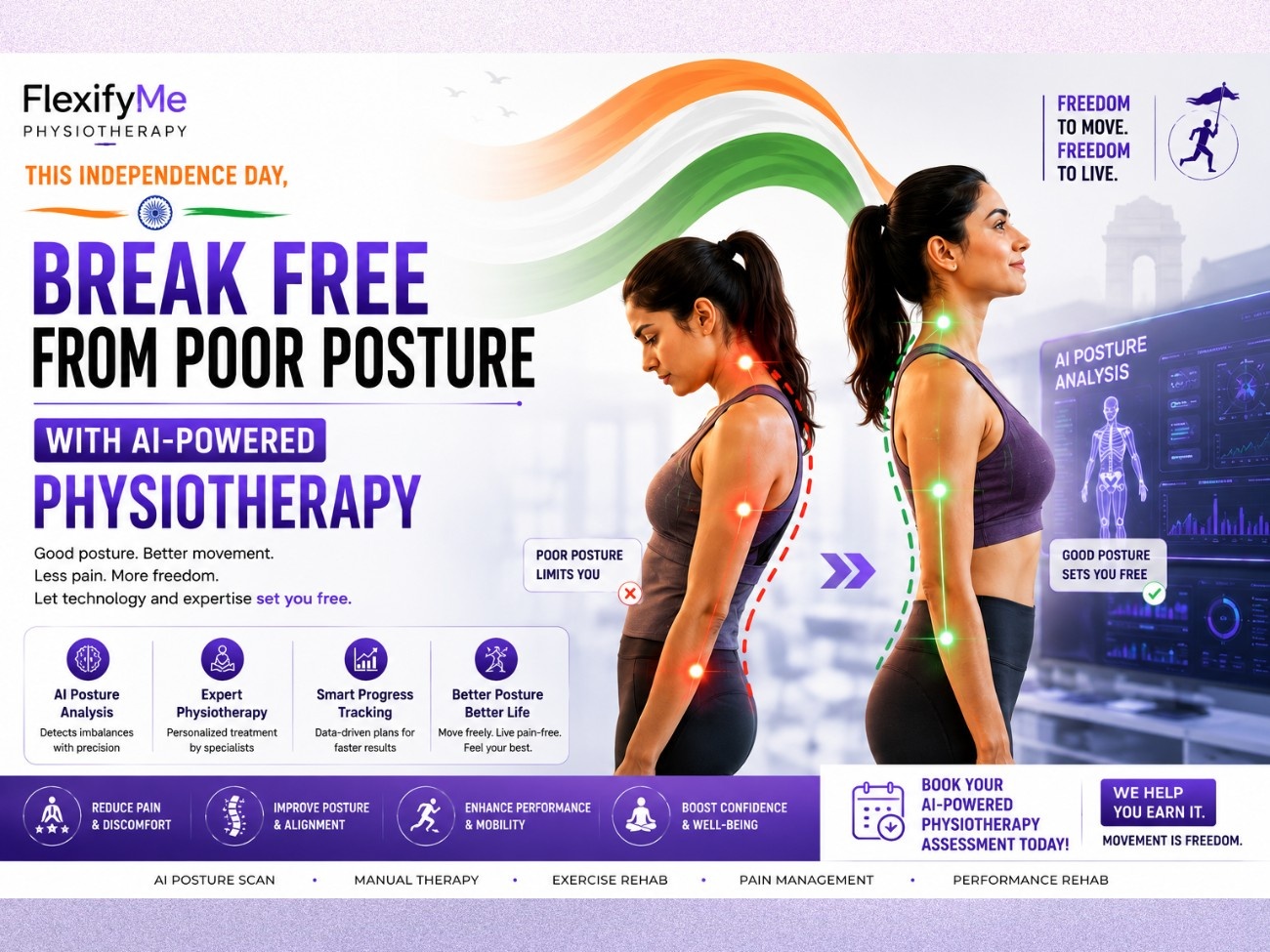
This Independence Day, Break Free From Poor Posture With AI-Powered Physiotherapy
Posture advice is some of the most repeated and least useful advice in health. Sit up straight. Do not slouch. Pull your shoulders back. Everyone has heard it, but reminders alone rarely create lasting change.
One reason is that posture advice is often given without meaningful measurement. You may be told that your head is too far forward or your shoulders are rounded, but not shown how much your posture changes over time or whether the exercises you are doing are making a measurable difference.
That is where AI-powered physiotherapy can add value. FlexifyMe's official website describes AI-powered scanning as part of its online physiotherapy process. The technology is used to assess body alignment and movement, after which the results are reviewed by a physiotherapist to develop a personalised recovery plan.
If you work at a desk in Model Town Phase 2 or anywhere across new delhi, understanding what this technology can and cannot do is useful.
What poor posture actually does
First, an important correction: posture alone is not necessarily the cause of pain. People can have visibly different postures without experiencing pain, while people with apparently good posture can still develop neck, shoulder or back discomfort.
The bigger issue is often how long your body stays in one position and whether your muscles and joints can tolerate that workload.
Sustained positions can contribute to:
Muscle fatigue, particularly around the neck, shoulders and upper back
Reduced movement, especially when you spend long periods in the same position
Repeated loading of the same tissues, which can become uncomfortable over time
Shoulder movement limitations, particularly when upper-back and shoulder mechanics are affected
Neck and upper-back discomfort associated with prolonged laptop and phone use
Common patterns include forward head posture, rounded shoulders and changes in the upper-back position. Tech neck is the everyday term often used for posture associated with prolonged device use.
The aim of posture physiotherapy should therefore not be to force everyone into one supposedly perfect position. It should be to understand your movement, symptoms, strength and daily habits, then identify what actually needs attention.
What AI adds to posture assessment
FlexifyMe specifically offers AI Postural Assessment. According to its official website, the technology uses AI to analyse posture and can help physiotherapists identify postural imbalances, misalignments and movement patterns. It can also measure aspects such as alignment, symmetry and angles involving areas including the head, shoulders, spine, pelvis, hips and knees.
Used as part of physiotherapy, AI can therefore support several parts of the assessment process:
Posture analysis: AI-assisted scanning can provide data about body alignment rather than relying only on visual observation.
Objective measurements: Measurements can provide a baseline that can be reviewed as treatment progresses.
Progress tracking: Repeat assessments can help show whether measurable changes have occurred.
Movement analysis: The technology can support assessment of movement and alignment patterns.
Personalised planning: FlexifyMe states that scanning results are reviewed by a physiotherapist before a customised recovery plan is developed.
This distinction matters. AI does not replace the physiotherapist in FlexifyMe's process. The company's online physiotherapy model combines technology-assisted scanning with one-to-one sessions and physiotherapist-led interpretation.
What AI cannot do
Being clear about the limits is just as important as understanding the benefits.
AI measurements are not a diagnosis. A posture deviation does not automatically mean that something is medically wrong.
Technology does not replace clinical assessment. Symptoms, medical history, strength, movement limitations and other factors still need professional interpretation.
A measurement does not automatically tell you what to treat. The same posture finding can have different significance for different people.
AI does not replace professional judgement. FlexifyMe's process specifically states that scanning results are analysed by a physiotherapist or expert before a recovery plan is created.
Not every posture difference needs correcting. The goal should be improved comfort, movement and function rather than chasing an arbitrary ideal alignment.
In other words, AI is a support tool within physiotherapy, not a substitute for a qualified physiotherapist.
What a posture programme should actually involve
Posture correction is unlikely to come from simply remembering to sit upright. A useful programme should consider movement, strength and your everyday environment.
Mobility
If your upper back, shoulders or neck have limited movement, maintaining a different position can feel uncomfortable or tiring.
A physiotherapist can assess which areas actually need mobility work rather than assuming that every tight muscle needs stretching.
Strength and endurance
Maintaining a comfortable working position for several hours is partly an endurance task. Strengthening the muscles around the neck, shoulders, upper back and trunk can help improve your ability to tolerate everyday activities.
Posture correction exercises should therefore be selected according to your assessment, rather than copied from a generic routine.
Habit and environment
Your workstation also matters. Practical changes may include:
Positioning your screen at a comfortable viewing height
Adjusting your chair and desk so your arms are comfortably supported
Holding your phone higher instead of spending long periods looking down
Taking regular movement breaks during prolonged desk work
Breaking long periods of sitting with short bouts of walking or movement
Choosing a realistic home exercise routine that you can consistently follow
FlexifyMe states that its physiotherapy sessions can include posture correction strategies and movement-based rehabilitation, with plans adjusted as progress is monitored.
How long does posture correction take?
There is no single timeline because posture-related discomfort can have different causes and may have been present for a long time.
Some people may notice improved awareness or movement relatively quickly. Building strength and endurance takes more consistent practice, while changing daily habits can take longer.
The important measure is not whether you can temporarily "sit straight". It is whether your movement, comfort and ability to tolerate daily activities are improving.
Who should consider a posture assessment?
A posture assessment may be useful for:
Desk workers who regularly develop neck, shoulder or upper-back discomfort
People who experience discomfort after long periods of laptop or phone use
Anyone who has noticed changes in their standing or sitting posture
People with recurring neck or upper-back stiffness
Students who spend long periods studying at desks or using laptops
People who have repeatedly been told to "fix their posture" but have never had their movement properly assessed
FlexifyMe's official website states that its online physiotherapy service can support people experiencing posture-related discomfort and movement limitations. Its AI Postural Assessment is also presented as a tool for identifying postural imbalances and supporting personalised treatment planning.
If you have significant symptoms such as arm weakness, numbness, hand clumsiness, difficulty walking or neck pain following an accident, seek appropriate medical assessment rather than relying on a posture scan alone.
How FlexifyMe's AI-powered physiotherapy process works
FlexifyMe describes a four-step process for its online physiotherapy service:
1. AI-powered scanning
The technology is used to understand aspects of your body's alignment, strength and movement.
2. One-to-one physiotherapist session
The scanning results are reviewed by a physiotherapist or expert to better understand your individual condition.
3. Detailed assessment and personalised plan
FlexifyMe states that information from the technology and physiotherapist is combined to develop a customised recovery plan.
4. Ongoing programme and progress monitoring
The programme then continues under expert guidance, with progress monitored as treatment develops.
This approach is different from downloading an app or following a generic posture video because the technology is used alongside professional physiotherapy rather than instead of it.
Frequently Asked Questions
Is AI-powered physiotherapy as good as seeing a physiotherapist? AI-powered assessment is not a replacement for seeing a physiotherapist. At FlexifyMe, AI-assisted scanning is incorporated into a process where scanning results are reviewed by a physiotherapist, followed by one-to-one sessions and a personalised recovery plan.
Can bad posture be corrected permanently? There is no single permanent posture that everyone needs to maintain. Improving strength, mobility, movement habits and workstation setup can help you maintain more comfortable movement, but daily habits still matter.
Do posture correctors and braces work? They may provide a reminder to change position, but they should not be treated as a replacement for appropriate exercise, movement and professional assessment when needed.
Does poor posture cause neck pain? Sustained positions can contribute to neck discomfort, but posture is rarely the only factor. Activity levels, sleep, stress, strength, movement habits and other factors can also influence symptoms.
How often should I check my posture progress? The appropriate timing depends on the programme. Periodic reassessment can be more useful than repeatedly checking your posture every day, because meaningful physical changes generally require consistent practice.
Is it too late to work on posture in your forties or fifties? No. Strength, mobility and movement habits can be worked on at different ages. The appropriate approach depends on your individual symptoms and physical capacity.
Break the habit, not just the slouch
Posture is not simply a discipline problem. It can involve mobility, strength, movement habits and the environment in which you work.
If you have been carrying a stiff neck, aching shoulders or recurring discomfort through your working week, an assessment can help identify what actually needs attention. FlexifyMe's AI-powered physiotherapy process combines AI-assisted scanning with physiotherapist-led assessment, personalised recovery planning and progress monitoring.
For people seeking physiotherapy for posture in Model Town Phase 2 or new delhi, explore whether FlexifyMe's online physiotherapy service is suitable for your needs.
This article is for general information and is not a substitute for personal medical advice. Seek prompt medical care for significant weakness, numbness, hand clumsiness, difficulty walking, or symptoms following an accident.